Frans August Larson
Swedish missionary-turned-businessman styled the "Duke of Mongolia" (Chinese title Lan xiansheng, Mr. Lan), a duke/gung title reportedly conferred by the Bogda Khan of Urga during Outer Mongolia's early independence period; later a Sunid-circle intimate, present at the October 1934 Bat-khaalag autonomy conference, and a liaison between Demchugdongrub and Westerners.
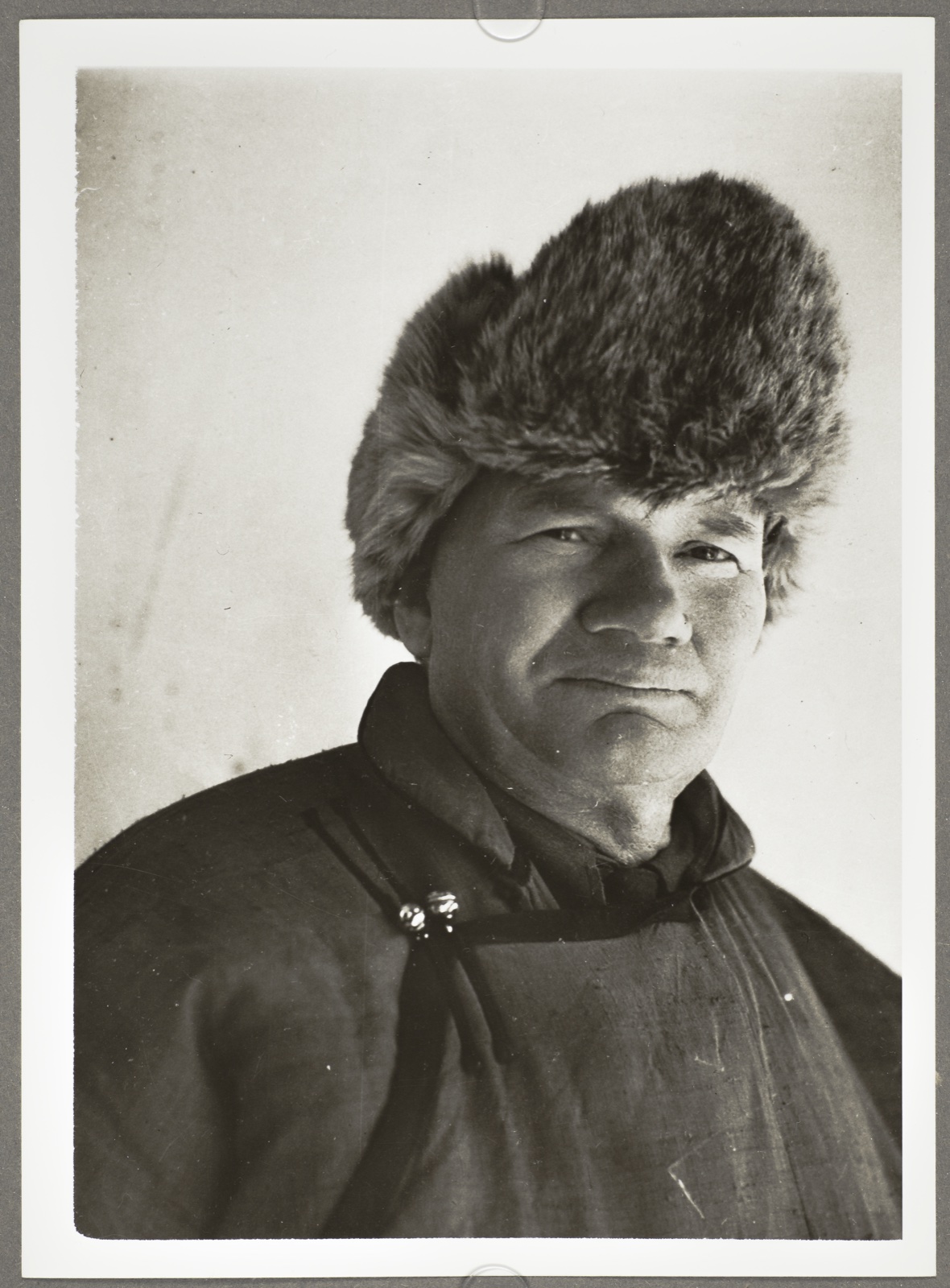
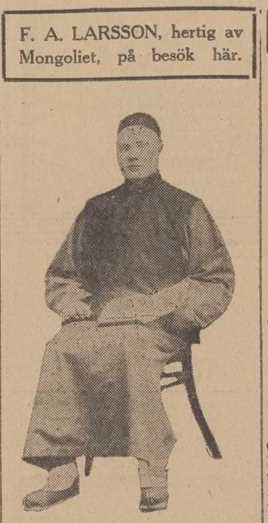
Frans August Larson, known in Chinese as Lan xiansheng (Mr. Lan) and in Sweden as “Hertig Larson,” the Duke of Mongolia, was a Swedish missionary who moved into business and then into an informal diplomatic-liaison role in Mongolia. He is documented in this atlas’s held sources moving in the Sunid/De Wang circle and, on at least one occasion, as Demchugdongrub’s own houseguest. The frontmatter years above mark the earliest and latest specific years attached to him in the sources this entry draws on (the 1919–1920 Beijing mission and the October 1934 Bat-khaalag conference respectively), not a birth-death span or the full length of his Mongolia career, which the atlas’s working notes place roughly 1893–1939 in general terms broader than what the sources below individually confirm.
Title, business, and the 1919–1920 Beijing mission
Sechin Jagchid records that Larson held the Chinese title Lan xiansheng and had received a gung (duke) title from the Bogda Khan of Ulaanbaatar during the early period of Outer Mongolian independence (Jagchid). Independently, Uranchimeg Tsultemin’s peer-reviewed study of a Library of Congress thangka states that Larson’s title was conferred specifically by the Eighth Jebtsundamba Bogdo Gegeen (1870–1924) at some point during Larson’s “35 years of life in Mongolia” (Tsultemin, pp. 74–75). This atlas treats the two as corroborating rather than conflicting, since the Bogda Khan and the Eighth Jebtsundamba Bogdo Gegeen are the same office and figure named two different ways, not two different grantors; neither source gives an exact year for the grant, so the precise date remains open (see verify-gates below).
Tsultemin also documents Larson’s business career: he ran Larson & Co., dealing in wool and cattle, and served as the Urga representative of the Danish-American firm Andersen, Meyer and Company (Tsultemin, pp. 74–75, citing Larson’s own 1930 memoir, Duke of Mongolia, at pp. 242, 244, 245, and 251). Jagchid separately places Larson in the entourage of the 1919–1920 Jalkhanza Khutugtu mission to Beijing, on which Larson was working for an American trading company operating out of Ulaanbaatar and Kalgan; the mission’s aim was to seek American intervention, and it failed (Jagchid).
Two separate 1920s expeditions, not one event
Two distinct documented associations exist between Larson and named foreign expeditions in the 1920s, and this atlas records them side by side rather than merging them. Tsultemin’s footnote 47 states that Larson joined Roy Chapman Andrews’s Third Central Asiatic Expedition as an interpreter in 1922 (Tsultemin, n. 47). This is separate from Larson’s participation in Sven Hedin’s 1927–28 Baotou-to-Urumqi expedition, recorded in the Alvin/Uppsala University Library biographical note accompanying the Bosshard portrait catalogued below (record 195718). Neither source states or implies that one of these is a misdating of the other; they are recorded here as two different expeditions five to six years apart.
Settlement in Chahar and the Sunid circle
Per Jagchid, Larson settled in Aduuchin Pasture, Chahar (later Shangdu Banner), after the Outer Mongolian revolution and remained there until the Japanese invasion. Jagchid describes him as fluent in Mongolian and a friend of Demchugdongrub’s. Larson was present at Beile-yin sume (the temple complex at Bat-khaalag) during the October 1934 autonomy conference, alongside Owen Lattimore, where he expressed goodwill toward the Mongol cause and helped win it sympathetic foreign press coverage (Jagchid). Jagchid also describes Larson’s broader role, beyond this one conference, as a liaison between the prince and Westerners.
A visit to the Sunit palace, ca. 1932 (inferred)
Larson’s own memoir, Duke of Mongolia (1930), includes a chapter, “The Nobles,” recounting a visit to the Sunit palace. The book’s 1930 publication date sets an outer bound, but Larson describes “the Prince of Sunit” in the visit itself as “a tall, thin young man of thirty years”; since Demchugdongrub was born in 1902, that description places the visit at approximately 1932. This atlas states that dating as an inference from internal textual evidence, not a date Larson gives directly, and marks it “ca. 1932 (inferred)” throughout rather than as a bare date. (Because the visit’s internal evidence points past the book’s own 1930 publication date, the chapter’s placement in Larson’s published 1930 memoir and the ca. 1932 internal dating of the episode it describes sit in some tension; this atlas records both facts as given rather than resolving the discrepancy.)
By his own account Larson had known the Prince since childhood, had known his father (the previous ruler), and had known an uncle who served as regent in Urga after his brother’s death, during the current Prince’s minority.
The previous ruler’s household, kept distinct here from the current Prince’s own family below: the previous ruler (Demchugdongrub’s father) had three wives. The first died without issue. The second, 58 years old at the time of Larson’s visit, was also childless; Larson credits her with installing what he describes as the first bathroom known in a Mongolian home, against local superstition. The third was a commoner’s daughter chosen for her family’s fertility, and bore two sons, one of them the current Prince.
The current Prince’s own household: separately from the above, Demchugdongrub’s own young wife was pregnant at the time of the visit, with the state hoping for a son to secure the succession.
This atlas flags, without attempting to resolve, a tension in Larson’s account: a ten-year-old heir apparent is present during this same visit and described as the Prince’s own son, sitting awkwardly against the same text’s framing that succession was not yet secure and a new son was being hoped for. Larson’s text does not explain this, and this atlas does not guess at the existing heir’s mother’s identity or status to reconcile it.
Larson also records Demchugdongrub’s stated political concern at the time: how to respond to the Nationalist government’s invitation to cooperate, and his position as having been asked by the rulers of ten independent Mongol states to lead their dealings with foreign powers, framing that reads as a precursor to the autonomy movement that followed from 1933. In Larson’s account, the Prince sent a cousin in his own place to Nanjing, described only as “a Mongolian duke” fluent in Tibetan, Chinese, and Mongolian, who had passed a Chinese literary exam in 1895 and held a Qing court position carrying peacock-feather and sapphire-button privileges. This atlas flags this cousin explicitly as an unidentified person and does not attempt to match him to anyone else in the atlas without independent confirmation. Larson also describes the Prince’s brother as head lama of the Sunit State Lamassery; whether this matches any other named figure already in this atlas is flagged as unconfirmed and is not merged with any existing entry absent explicit confirmation.
Sources
- Sechin Jagchid, The Last Mongol Prince: The Life and Times of Demchugdongrob, 1902–1966 (Center for East Asian Studies, Western Washington University, 1999), pp. 19–20, 77–78, cited above as “Jagchid.” See the Sechin Jagchid entry for his biography and this atlas’s standing caveat on weighing his participant-partisan perspective; he was personally close to Demchugdongrub’s circle, which this material shares in full.
- Uranchimeg Tsultemin, “A Thangka in the Library of Congress,” Mongolian Studies XXXV (2013), pp. 74–75 and nn. 47–52, cited above as “Tsultemin.” Peer-reviewed secondary scholarship, independent of Jagchid; cites Larson’s own 1930 memoir directly with page numbers.
- Frans August Larson, Duke of Mongolia (Boston: Little, Brown and Company, 1930), excerpted chapter “The Nobles,” pp. 36–45, cited above as “Larson’s memoir” or by chapter. Public domain (1930 US publication). Primary source, participant-observer memoir; weight Larson’s own self-characterization with the same care given to any memoir source in this atlas, since he is recounting his own history and connections.
- Alvin (Uppsala University Library digital platform), catalog biographical note accompanying record 195718 (“0178: Hertig Larsson,” Joel Eriksson 9I:178), cited above as “the Alvin biographical note.” Institutional cataloguing metadata, used here only for the Sven Hedin 1927–28 expedition detail; not independently checked by this atlas against Hedin’s own published account.
Verify-gates (open, see this atlas’s project notes for the full list): the precise year the duke/gung title was conferred; the identity of the unnamed cousin sent to Nanjing; whether the Prince’s brother, described here as head lama of the Sunit State Lamassery, matches any other figure already in this atlas; and Odelberg 2003, Hertig Larson: Äventyrare, Missionär, Upptäckare, not yet held, which would allow a fuller biographical treatment than the three sources above support on their own.